
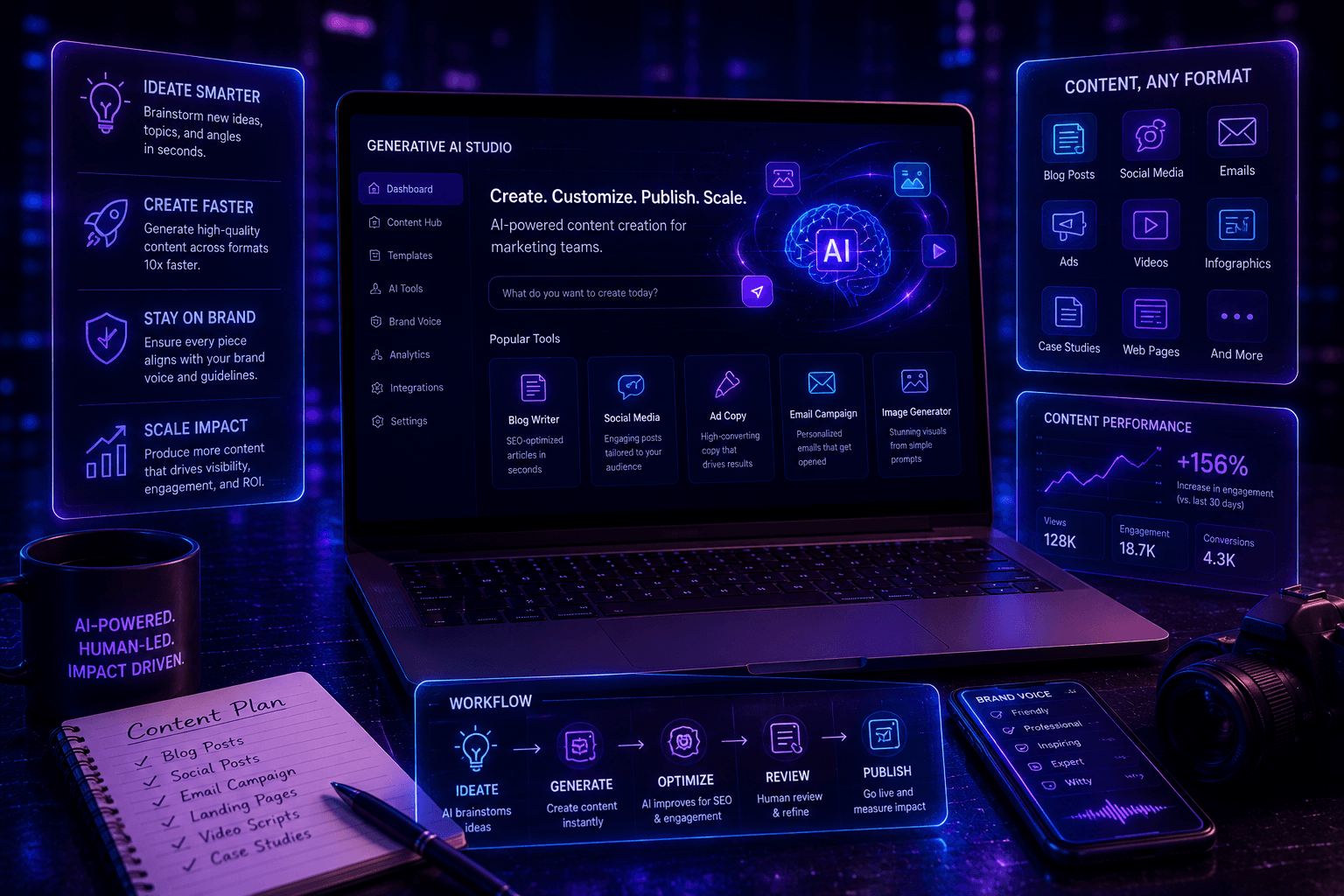

Introduction: The Generative AI Revolution in Content Marketing
In today's fast-paced digital landscape, content is king. Marketing teams are constantly challenged to produce high-quality, engaging content at scale to capture audience attention and drive business growth. This demand, however, often strains resources, leading to bottlenecks in creation, increased costs, and a struggle to maintain consistency. Enter Generative AI, a transformative technology poised to revolutionize how we approach content marketing. Generative AI refers to artificial intelligence systems capable of creating new, original content – from text and images to code and audio – based on the data they are trained on. Its growing importance in content marketing stems from its ability to address these very challenges: offering unprecedented scalability, reducing creation time and costs, and accelerating the content production cycle. This guide will explore how marketing teams can harness the power of Generative AI to unlock new levels of efficiency and creativity, ultimately achieving more with less.
Quick Answer: How Can Generative AI Help Marketing Teams?
Generative AI empowers marketing teams by automating and accelerating content creation across various formats, from blog posts and social media updates to email campaigns and video scripts. It helps overcome scalability issues, reduce costs, and speed up production, allowing teams to focus on strategy and refinement.
Understanding the Core Concepts of Generative AI for Content
To effectively leverage Generative AI, it's crucial to grasp its fundamental concepts. At its core, Generative AI utilizes sophisticated algorithms, often built upon large language models (LLMs) like GPT or diffusion models for image generation, to learn patterns from vast datasets and then produce novel outputs. These models can be broadly categorized by their output: text generation models create written content, image generation models produce visuals, and code generation models assist in programming tasks. Understanding common AI jargon is also key. A 'prompt' is the input or instruction given to the AI, guiding its output. 'Parameters' are settings that control the AI's behavior, influencing creativity or specificity. 'Fine-tuning' involves further training a pre-existing model on specific data to tailor its responses to a particular domain or brand. While powerful, it's important to address potential concerns. Questions about originality, the risk of bias inherited from training data, and the overall quality of AI-generated content are valid and require careful consideration and human oversight.
Identifying Content Creation Opportunities with Generative AI
- Brainstorming and ideation: Overcome writer's block by generating diverse content ideas, topics, and outlines.
- Drafting initial content: Accelerate the creation of blog posts, articles, website copy, and product descriptions.
- Social media content: Quickly produce engaging captions, posts, tweets, and story ideas tailored for different platforms.
- Email marketing campaigns: Generate compelling subject lines, personalized body copy, and promotional content.
- Video and audio scripts: Develop scripts for explainer videos, podcasts, or marketing presentations.
- Content personalization: Create variations of content tailored to specific audience segments, improving relevance and engagement.
- Repurposing content: Transform existing content into new formats, such as turning a blog post into a social media thread or video script.
Implementing Generative AI Tools in Your Marketing Workflow
Integrating Generative AI into your marketing workflow can be streamlined with the right tools and approach. Popular platforms like OpenAI's ChatGPT, Jasper, Copy.ai, and Midjourney offer diverse capabilities for text and image generation. The key to successful implementation lies in a step-by-step process: start by identifying specific content needs that AI can address, select the appropriate tools, and then integrate them thoughtfully into your existing processes. Effective 'prompt engineering' is crucial; learning to write clear, specific, and context-rich prompts will significantly improve the quality of AI outputs. Provide the AI with background information, desired tone, target audience, and key objectives. Remember, AI is a powerful assistant, not a replacement for human judgment. Always edit, refine, and fact-check AI-generated content to ensure accuracy, maintain brand voice consistency, and uphold quality standards. Human oversight remains paramount for strategic direction and final approval.
Measuring the ROI of Generative AI in Content Marketing
To justify investment and optimize strategy, measuring the return on investment (ROI) of Generative AI in content marketing is essential. Key metrics to track include increased content output volume, improvements in engagement rates (likes, shares, comments), higher conversion rates from AI-assisted content, and demonstrable cost savings from reduced production time and resources. Attribution can be challenging but can be approached by comparing performance metrics of AI-generated or AI-assisted content against purely human-created content. A/B testing different versions of content – one AI-generated and one human-written, or variations of AI prompts – can provide valuable insights into effectiveness. Analyzing case studies of companies that have successfully implemented Generative AI can also offer benchmarks and inspiration for your own initiatives, highlighting tangible benefits like faster campaign launches and improved lead generation.
Addressing the Challenges and Ethical Considerations of AI Content
While Generative AI offers immense potential, navigating its challenges and ethical considerations is vital. Ensuring originality and avoiding unintentional plagiarism requires careful review and the use of plagiarism detection tools. Maintaining brand consistency and quality control necessitates robust editing processes and clear guidelines for AI usage. Addressing potential biases and inaccuracies inherent in AI models requires critical evaluation of outputs and, where possible, fine-tuning models with diverse and representative data. Transparency and disclosure regarding the use of AI-generated content are increasingly important for building trust with audiences. Furthermore, the role of human content creators is evolving, not disappearing; AI tools augment human creativity, allowing professionals to focus on higher-level strategy, editing, and nuanced storytelling. The future lies in a collaborative human-AI approach.
Future Trends in Generative AI and Content Marketing
The landscape of Generative AI and its impact on content marketing is rapidly evolving. We can expect more sophisticated AI models capable of generating even more nuanced, creative, and context-aware content. The rise of hyper-personalized and interactive AI-powered content experiences will allow brands to connect with audiences on a deeper level. Integration with other marketing technologies, such as CRMs and advanced analytics platforms, will enable more seamless workflows and data-driven content strategies. AI's potential to automate increasingly complex content tasks, from market research summarization to multi-channel campaign creation, will continue to grow, further transforming the marketing function.
Generative AI is unlikely to fully replace human content creators but will act as a powerful co-pilot, augmenting their capabilities. Focus on strategic tasks, creativity, and final editing. Always use plagiarism checkers and cross-reference information to ensure originality. Key risks include potential bias, factual inaccuracies, and maintaining brand voice, all mitigated by human oversight. Implementation costs vary widely depending on the tools and scale of use, with many accessible options available.
Conclusion: Embrace the Power of Generative AI for Content Success
Generative AI presents an unparalleled opportunity for marketing teams to scale their content creation efforts, enhance efficiency, and drive better results. By understanding its capabilities, strategically implementing the right tools, and maintaining critical human oversight, you can unlock new levels of creativity and productivity. Experimentation is key; start small, learn from your results, and gradually integrate AI into your broader content strategy. The future of content marketing is here, and it's powered by the intelligent collaboration between human ingenuity and artificial intelligence. Embracing Generative AI is not just about staying current; it's about gaining a significant competitive advantage.
CTA: Unlock Scalable Content Creation with BigOsoft
Ready to harness the power of Generative AI for your marketing? BigOsoft offers cutting-edge AI-powered content solutions and expert services designed to help your team create high-quality content at scale, efficiently and effectively. Let us guide you through the integration process and tailor strategies to meet your unique business goals. Contact BigOsoft today for a free consultation and discover how we can transform your content marketing.