
Introduction: AI Task Automation Arrives on Mobile
AI task automation is rapidly evolving, moving beyond complex enterprise solutions to become an integral part of our daily digital interactions. Its growing importance lies in its ability to simplify complex processes, enhance efficiency, and deliver more intuitive user experiences. The recent integration of Google's Gemini AI with popular platforms like Uber and DoorDash marks a significant milestone, signaling a new era for AI-powered mobile applications. This integration allows users to perform everyday tasks, such as ordering a ride or food, directly through conversational AI, demonstrating the immense potential of AI task automation on mobile devices. For Product Managers and Mobile Developers, understanding and leveraging these advancements is crucial for staying ahead in a competitive landscape. This post will delve into the intricacies of this integration, explore its benefits for various stakeholders, and paint a picture of the future of AI-powered mobile experiences.
Quick Answer
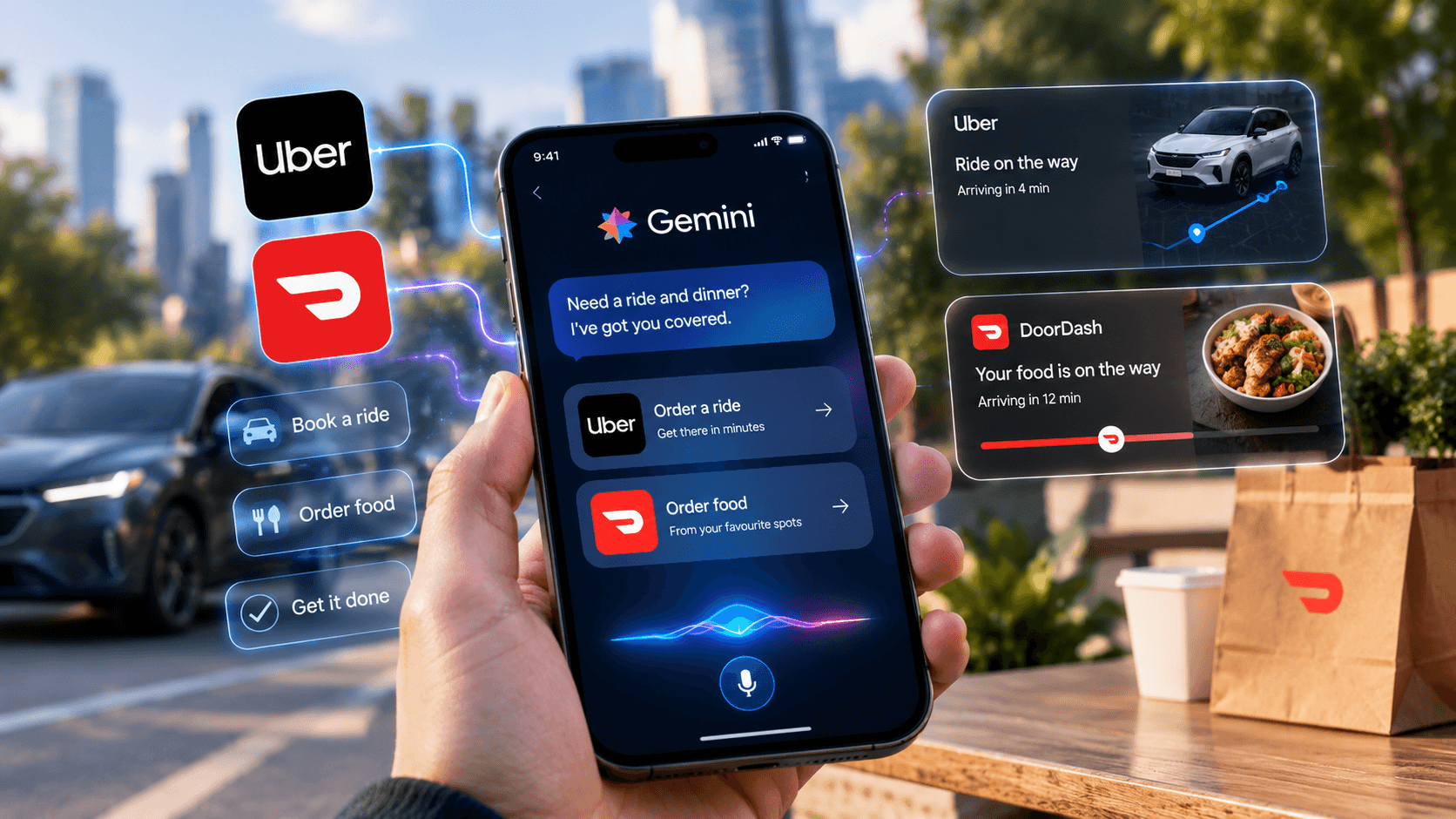
Gemini's integration with Uber and DoorDash enables users to seamlessly order rides and food through natural language commands within the Gemini interface. This showcases the future of AI task automation on mobile by simplifying complex app interactions into conversational requests, making everyday tasks more efficient and accessible.
Understanding Gemini's Integration with Uber and DoorDash
- The core functionality of this integration lies in its ability to connect Gemini's advanced AI capabilities with the service offerings of Uber and DoorDash. Users can initiate requests for rides or food delivery by simply typing or speaking their needs to Gemini, without needing to open the individual Uber or DoorDash apps.
- Users can leverage Gemini to order rides by stating their destination and desired pickup time, or to order food by specifying the restaurant and desired menu items. Gemini then translates these natural language requests into actionable commands within the partner apps.
- The focus is on delivering a seamless user experience on mobile. Instead of navigating multiple app interfaces, users can manage these tasks through a single, unified conversational AI, reducing friction and saving time.
- The underlying AI technology powering this integration involves sophisticated natural language understanding (NLU) to interpret user intent, complex reasoning to formulate appropriate actions, and secure API integrations to communicate with Uber and DoorDash's backend systems. Gemini's multimodal capabilities may also play a role in understanding more nuanced requests.
Benefits for Product Managers: Streamlining Mobile Experiences
- Product Managers can leverage AI task automation by identifying repetitive or complex user journeys within their apps and exploring how AI can simplify them. This could involve automating onboarding processes, simplifying search functionalities, or enabling in-app task completion via natural language.
- By offering more intuitive and efficient ways to interact with an app, AI can significantly improve user engagement and retention. When users find an app easy and enjoyable to use, they are more likely to return.
- AI enables the creation of more personalized mobile apps. By understanding user behavior and preferences, AI can tailor content, recommendations, and even the app's interface to individual needs, making the experience feel more intuitive and relevant.
- This integration opens up opportunities for entirely new features and functionalities. Imagine an app that can proactively suggest actions based on user context, or allow users to control app features through voice commands, offering a richer and more interactive experience.
Advantages for Mobile Developers: Building the Future of AI-Powered Apps
- Mobile Developers can integrate similar AI capabilities by leveraging cloud-based AI services and APIs. This involves understanding how to process natural language input, connect to backend services, and manage the flow of information between the AI and the application.
- Exploring the technical aspects of the Gemini integration reveals the power of robust API design and secure authentication protocols. Developers need to understand how to securely expose and consume APIs that allow AI agents to interact with application functionalities.
- Leveraging APIs and SDKs provided by AI platforms (like Google AI, OpenAI, etc.) is key for AI task automation. These tools abstract away much of the complexity of AI model training and deployment, allowing developers to focus on integrating AI features into their apps.
- Best practices for building secure and reliable AI-powered mobile apps include rigorous testing, implementing strong data privacy measures, ensuring ethical AI usage, and providing clear feedback mechanisms for users to report issues or provide input.
Use Cases: Real-World Applications of AI Task Automation
- Ordering food while multitasking: A user can ask Gemini to 'Order my usual from Pizza Place for delivery in 30 minutes' while driving or in a meeting, and Gemini handles the rest.
- Scheduling rides for appointments: 'Book me an Uber to the airport for tomorrow at 7 AM' can be a simple voice command, ensuring timely transportation without manual app interaction.
- Potential applications in other industries are vast. In e-commerce, AI could help users find and purchase products through conversation. In travel, it could assist in booking flights and hotels based on complex criteria. Even in healthcare, AI could help patients schedule appointments or refill prescriptions.
The Future of AI Task Automation on Mobile Devices
- Predictions for the evolution of AI task automation point towards increasingly proactive and context-aware assistants. AI will anticipate user needs and offer solutions before they are even requested.
- The role of AI in creating more personalized and efficient mobile experiences will be paramount. AI will move beyond simple task execution to become a true digital companion, understanding individual routines and preferences.
- Emerging trends and technologies include advancements in large language models (LLMs), on-device AI processing for enhanced privacy and speed, and the integration of AI across multiple devices and platforms for a seamless ecosystem.
- The impact of AI on the mobile app development landscape will be profound, shifting the focus from building feature-rich interfaces to designing intelligent, conversational experiences. Developers will need to adapt their skill sets to incorporate AI integration as a core competency.
Challenges and Considerations
- Addressing potential privacy concerns is critical. Users need to trust that their data is being handled responsibly and that AI interactions are not being misused.
- Ensuring data security and ethical AI practices involves implementing robust security measures, adhering to privacy regulations, and developing AI systems that are fair, unbiased, and transparent.
- Overcoming technical challenges in integrating AI into mobile apps can include managing computational resources, ensuring low latency for real-time interactions, and handling complex data processing on resource-constrained devices.
- Maintaining user trust and transparency is fundamental. Users should understand how AI is being used, what data is being collected, and have control over their AI interactions. Clear communication and user education are key.
Conclusion: Embracing the AI-Powered Mobile Revolution
Gemini's integration with Uber and DoorDash is a powerful demonstration of how AI task automation can fundamentally change the way we interact with our mobile devices. It streamlines complex processes, enhances user convenience, and unlocks new possibilities for app functionality. For Product Managers and Mobile Developers, embracing this AI-powered mobile revolution is not just an option, but a necessity for creating competitive and engaging applications. The ability to automate tasks through natural language and intelligent assistance will define the next generation of mobile experiences. By understanding the benefits, potential use cases, and challenges, we can begin to harness the full power of AI to build smarter, more efficient, and more user-centric mobile solutions. The future of mobile is intelligent, and AI task automation is at its core.
FAQ
- What is AI task automation?
- AI task automation refers to the use of artificial intelligence to perform tasks that would typically require human intervention, such as data entry, scheduling, or customer service interactions, thereby increasing efficiency and reducing errors.
- How does Gemini's integration benefit users?
- It allows users to perform actions within other apps (like ordering rides or food) directly through conversational commands in Gemini, simplifying the user experience and saving time.
- What are the key challenges in AI mobile app development?
- Key challenges include ensuring data privacy and security, managing computational resources on mobile devices, maintaining user trust through transparency, and overcoming the complexity of integrating AI models.
- Can any app integrate AI task automation?
- While the complexity varies, many apps can integrate AI task automation by leveraging available APIs and AI platforms, especially for tasks involving natural language processing or predictive analytics.
Ready to Transform Your Mobile App with AI?
The advancements in AI task automation, exemplified by integrations like Gemini's with Uber and DoorDash, are reshaping the mobile landscape. At BigOsoft, we are at the forefront of this transformation, helping businesses harness the power of AI to create intelligent, efficient, and user-centric mobile applications. Whether you're looking to streamline user journeys, develop innovative AI-powered features, or enhance user engagement, our expert team can guide you. Contact us today for a consultation and explore how our AI development services can help you build the future of AI-powered mobile experiences.