
Introduction: The AI Landscape for CTOs
The current technological revolution is undeniably driven by Artificial Intelligence (AI). For Chief Technology Officers (CTOs) and businesses alike, understanding and strategically implementing AI is no longer optional; it's a critical imperative for staying competitive. The rapid evolution of Large Language Models (LLMs) like OpenAI's ChatGPT and Anthropic's Claude presents both immense opportunities and complex choices.
CTOs must navigate this dynamic landscape, evaluating which AI platforms best align with their organization's goals, technical capabilities, and ethical considerations. This deep dive will equip you with the knowledge to make an informed decision between two of the leading AI contenders.
Quick Answer: ChatGPT vs. Claude
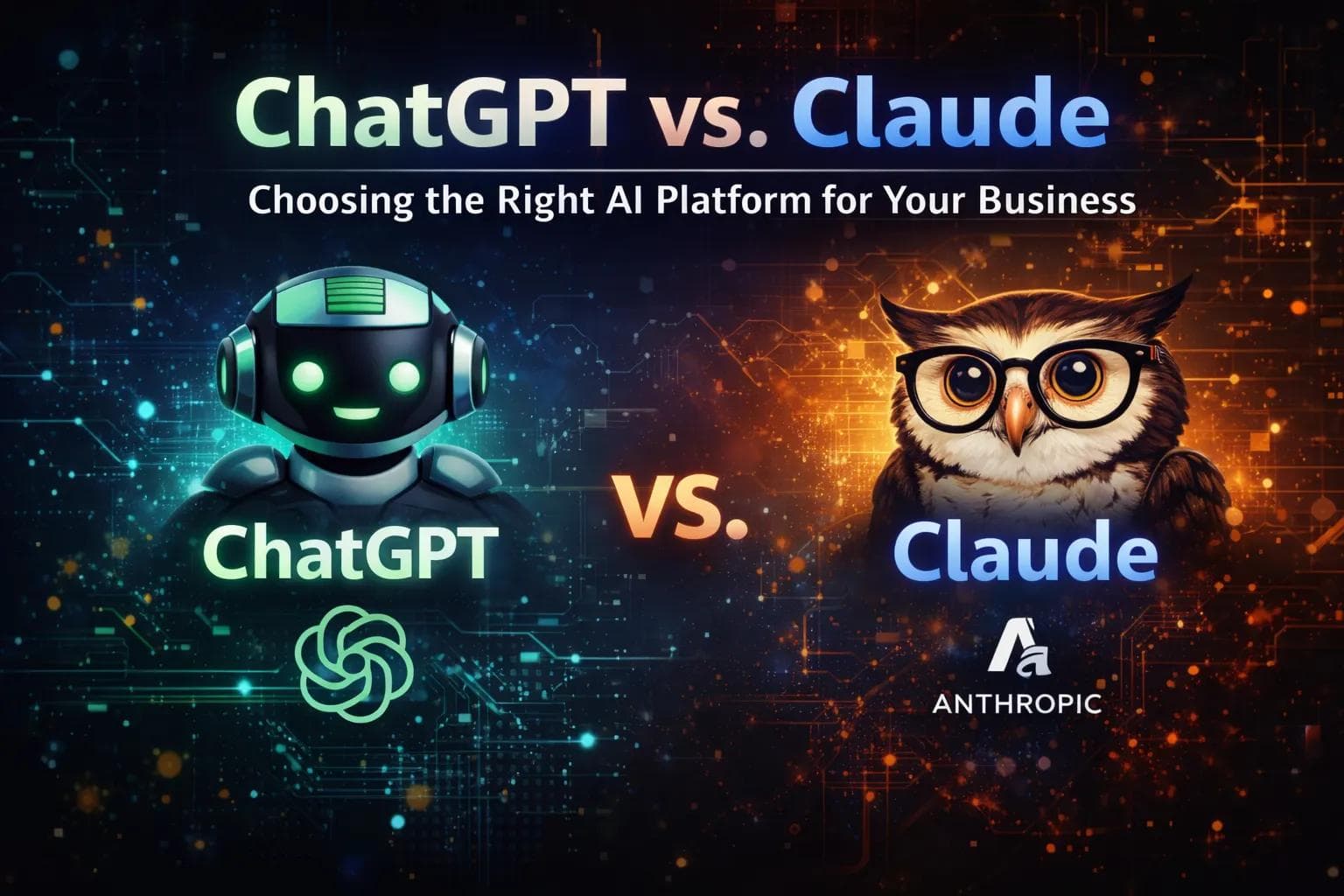
Choosing between ChatGPT and Claude depends on your specific business needs. ChatGPT excels in broad accessibility, user-friendliness, and general content creation, making it ideal for common tasks. Claude shines in complex reasoning, safety, and handling sensitive data, suited for specialized applications like legal or financial analysis. Evaluate your priorities regarding cost, data privacy, and task complexity to select the best fit.
ChatGPT: Strengths, Weaknesses, and Use Cases
ChatGPT, developed by OpenAI, has become a household name in the AI space. Its capabilities span a wide range, from generating human-like text for marketing copy and blog posts to assisting with code completion and debugging. Its primary advantages lie in its widespread availability, extensive training data derived from a vast internet corpus, and a generally intuitive user interface that lowers the barrier to entry for many users. This makes it a go-to for content creation, powering customer service chatbots, and providing basic coding assistance.
However, ChatGPT is not without its limitations. It can sometimes produce inaccurate or nonsensical information (hallucinations), struggle with highly nuanced or complex reasoning tasks, and raise data privacy concerns, especially when dealing with sensitive proprietary information. For CTOs, understanding these drawbacks is crucial when considering its integration into critical business workflows.
Claude: Strengths, Weaknesses, and Use Cases
Anthropic's Claude is built with a strong emphasis on safety, reliability, and ethical AI principles. Its capabilities are particularly impressive in handling nuanced tasks that require deep reasoning and understanding of context. Claude often demonstrates superior performance in areas like summarizing lengthy documents, analyzing complex legal texts, performing financial modeling, and processing sensitive data where accuracy and ethical considerations are paramount. Its architecture is designed to be more constitutionally aligned, meaning it adheres to a set of safety principles.
The trade-offs for Claude often include potentially higher costs compared to some of ChatGPT's offerings, more limited availability in certain regions or for specific features, and potentially a steeper learning curve for developers integrating its API due to its focus on safety guardrails. Its ideal use cases often involve domains where precision, safety, and ethical handling of information are non-negotiable.
Feature-by-Feature Comparison: ChatGPT vs. Claude
When evaluating these powerful LLMs, CTOs need a clear, feature-by-feature comparison. While specific pricing and model sizes can fluctuate, key differentiators often emerge:
- API Access & Integration: Both offer robust APIs, but integration complexity and documentation can vary. ChatGPT's API is widely adopted, while Claude's might require more careful consideration for specific safety protocols.
- Data Privacy & Security: Claude's design philosophy prioritizes safety and privacy, making it potentially more suitable for regulated industries. ChatGPT's data handling policies should be carefully reviewed for compliance.
- Model Size & Performance: Both companies are constantly updating their models. Generally, larger models offer more nuanced understanding but can be slower and more expensive. Performance on specific tasks (e.g., coding, creative writing, factual recall) can differ significantly.
- Speed & Latency: For real-time applications like chatbots, response speed is critical. This can depend on the specific model version and API load.
- Accuracy & Reliability: While both strive for accuracy, Claude's focus on safety may lead to more cautious and potentially more reliable outputs in sensitive contexts. ChatGPT might be more prone to confident-sounding inaccuracies.
- Supported Languages: Both support multiple languages, but the proficiency and nuance can vary.
- Cost: Pricing models differ, often based on token usage. Enterprise-level solutions and fine-tuning capabilities will impact overall cost.
For CTOs, security, scalability, and the ease of integration into existing tech stacks are paramount. Real-world examples often highlight Claude's strength in legal document review due to its ability to handle long contexts and maintain accuracy, whereas ChatGPT might be preferred for rapidly generating diverse marketing content.
Choosing the Right Platform: Key Considerations for CTOs
The decision between ChatGPT and Claude, or even exploring other emerging AI platforms, hinges on a thorough assessment of your unique business requirements. Ask yourself:
- What specific problems are we trying to solve with AI? Are we automating customer support, enhancing content creation, analyzing complex data, or something else entirely?
- What are our data security and compliance obligations? Industries like finance, healthcare, and law have stringent requirements that might favor platforms with a stronger emphasis on privacy and safety.
- What is our budget, and what resources (technical expertise, time) do we have available? Some platforms may have higher upfront costs or require more specialized skills to implement effectively.
- What are our scalability needs? Will the chosen AI solution need to handle increasing loads as our business grows?
- How important is long-term maintainability and ethical alignment? Consider the vendor's roadmap, commitment to responsible AI, and the ease of updating or modifying the AI's behavior.
Migrating to Claude: A Step-by-Step Guide
Should your evaluation lead you to choose Claude, a structured migration approach is essential. This typically involves several key phases:
- Planning & Assessment: Clearly define the scope of the migration. Identify the specific use cases Claude will address and map them against its capabilities. Assess your current data infrastructure and prepare it for integration.
- Data Preparation: Ensure your data is clean, relevant, and formatted appropriately for Claude's input requirements. This may involve data anonymization or structuring for optimal performance.
- API Integration: Develop or adapt your existing applications to interface with Claude's API. This requires understanding its request/response formats and authentication mechanisms.
- Testing & Validation: Rigorously test the integrated system. Compare Claude's outputs against your benchmarks and previous systems. Conduct user acceptance testing (UAT) to ensure it meets functional requirements.
- Addressing Challenges: Be prepared for potential compatibility issues with legacy systems or unexpected behaviors. Retraining or fine-tuning models might be necessary for highly specific tasks.
- Ensuring Data Security: Implement robust security measures throughout the migration process. Verify that data transmission and storage comply with all relevant regulations and your organization's policies.
Future Trends in AI: What CTOs Need to Know
The AI landscape is evolving at an unprecedented pace. Beyond ChatGPT and Claude, CTOs must stay informed about emerging trends. Multimodal AI, capable of understanding and generating not just text but also images, audio, and video, is rapidly advancing. Reinforcement learning techniques are enabling AI to learn through trial and error, leading to more sophisticated problem-solving capabilities. The importance of ethical AI development, bias mitigation, and transparent decision-making will only grow.
Staying ahead requires continuous learning and adaptation. Partnering with experts who understand these complexities can be invaluable. BigOsoft is dedicated to helping businesses navigate the future of AI, ensuring you leverage these powerful technologies effectively and responsibly.
Conclusion: Making an Informed Decision
Ultimately, the choice between ChatGPT and Claude is not about which AI is 'better' in an absolute sense, but which is the 'right fit' for your specific business objectives, technical infrastructure, and risk tolerance. ChatGPT offers broad utility and accessibility, while Claude provides advanced capabilities in safety, reliability, and complex reasoning.
A thorough evaluation, possibly including pilot projects for specific use cases, is the most prudent path forward. Understanding the nuances of each platform empowers CTOs to make strategic decisions that drive innovation and deliver tangible business value.