
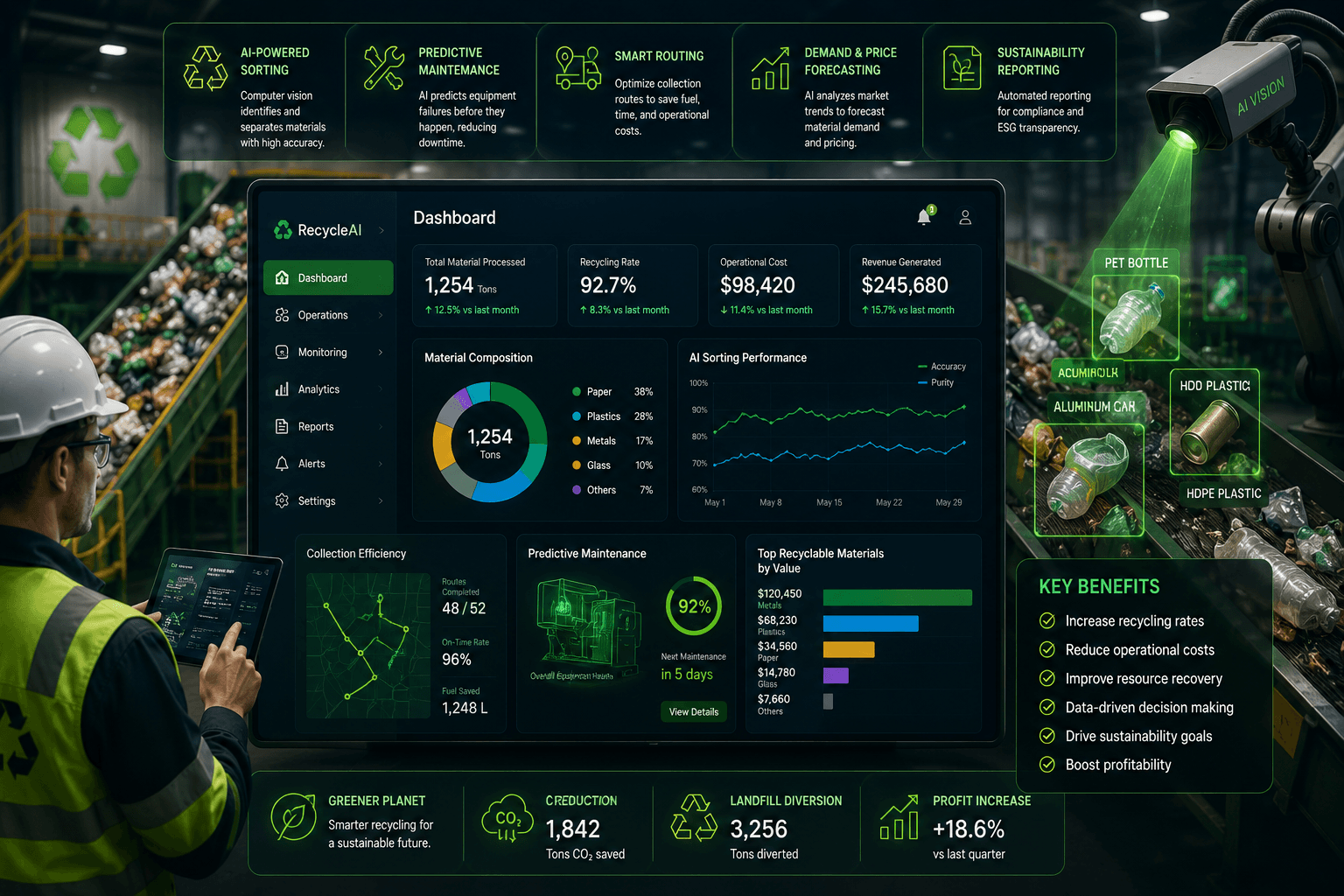

The global waste crisis is escalating, presenting significant challenges for waste management companies. Traditional recycling methods, often reliant on manual labor and basic machinery, are struggling to keep pace with the sheer volume of waste generated daily. This is where Artificial Intelligence (AI) emerges as a transformative force, offering innovative solutions to enhance efficiency, reduce operational costs, and unlock new revenue streams. Embracing AI in recycling is no longer a futuristic concept but a present-day necessity for companies looking to thrive in an increasingly complex and environmentally conscious world. The integration of AI promises to revolutionize how we approach waste management, making recycling processes smarter, faster, and more profitable.
The Growing Need for AI in Recycling
- The increasing volume of waste and the limitations of traditional recycling methods.
- Rising demand for recycled materials and stricter environmental regulations.
- The challenges of manual sorting and the high costs associated with contamination.
- How AI offers a solution to improve efficiency and reduce waste.
The sheer volume of waste produced globally continues to surge, overwhelming conventional recycling infrastructure. Manual sorting, while once the standard, is labor-intensive, prone to human error, and struggles to achieve the purity levels required by manufacturers of recycled goods. Furthermore, contamination – the presence of non-recyclable materials or impurities – significantly devalues recycled outputs and increases processing costs. Simultaneously, market demand for high-quality recycled materials is growing, driven by consumer preferences and corporate sustainability goals. Coupled with increasingly stringent environmental regulations, these factors create a compelling case for adopting advanced technologies. AI provides a powerful toolkit to address these challenges head-on, enabling waste management companies to sort materials more effectively, reduce contamination, and ultimately improve the overall efficiency and profitability of their operations.
How AI is Transforming Recycling Processes
- Automated waste sorting using computer vision and robotics.
- AI-powered quality control to identify and remove contaminants.
- Predictive maintenance for recycling equipment to minimize downtime.
- Optimized route planning for waste collection to reduce fuel consumption.
Artificial intelligence is fundamentally reshaping the recycling landscape by introducing automation, intelligence, and optimization across various stages of the waste management lifecycle. Advanced algorithms and machine learning models can analyze vast datasets to identify patterns, predict outcomes, and automate complex tasks. This translates into tangible improvements, from the initial sorting of waste streams to the final delivery of collected materials. By leveraging AI, companies can move beyond traditional, often inefficient, methods towards a more dynamic and data-driven approach. This technological shift not only enhances operational performance but also contributes significantly to environmental sustainability goals.
AI-Powered Waste Sorting: A Closer Look
- Using computer vision to identify different types of materials (plastics, paper, metal, etc.).
- Robotic arms and grippers for automated sorting at high speeds.
- Deep learning algorithms to improve accuracy and adapt to new waste streams.
- Examples of companies using AI for waste sorting and their results.
At the heart of AI's impact on recycling lies its ability to automate and refine the sorting process. Computer vision systems, powered by sophisticated AI algorithms, can meticulously scan incoming waste streams, identifying and differentiating between various materials like different types of plastics, paper, glass, and metals with remarkable accuracy. These systems can distinguish subtle variations in color, shape, and texture that might elude the human eye. Once identified, high-speed robotic arms equipped with specialized grippers can precisely pick and sort these materials at rates far exceeding manual capabilities. Deep learning, a subset of machine learning, allows these systems to continuously learn and improve, adapting to new packaging materials and evolving waste compositions without constant reprogramming. Companies like AMP Robotics have demonstrated significant success, with their AI-powered robots sorting recyclables at speeds up to 100 pieces per minute, achieving higher purity rates and diverting more waste from landfills.
Reducing Contamination with AI-Driven Quality Control
- Identifying non-recyclable items and contaminants in real-time.
- Using AI to analyze the composition of waste streams and optimize sorting processes.
- Alerting operators to potential problems and preventing contamination from spreading.
- The impact of reduced contamination on the quality and value of recycled materials.
Contamination is a persistent enemy of efficient recycling, leading to lower-quality end products and increased processing costs. AI-driven quality control systems offer a robust solution. By continuously analyzing the waste stream, AI can instantly detect and flag non-recyclable items, hazardous materials, or other contaminants that could compromise the entire batch. This real-time identification allows for immediate removal, preventing the spread of contamination. Furthermore, AI can analyze the overall composition of the waste, providing valuable insights that can be used to fine-tune sorting parameters and optimize the entire process. This proactive approach significantly improves the purity of sorted materials, making them more attractive to buyers and increasing their market value. The result is a more valuable and sustainable output from the recycling process.
Predictive Maintenance: Minimizing Downtime and Maximizing Uptime
- Using AI to analyze sensor data and predict equipment failures.
- Scheduling maintenance proactively to avoid costly repairs and downtime.
- Optimizing maintenance schedules based on equipment usage and performance.
- The benefits of predictive maintenance for reducing operational costs and improving efficiency.
Recycling facilities rely on heavy machinery that can be prone to unexpected breakdowns, leading to costly downtime and production delays. Predictive maintenance, powered by AI, offers a proactive solution. By analyzing data from sensors installed on equipment – monitoring factors like vibration, temperature, and operational load – AI algorithms can detect subtle anomalies that indicate potential future failures. This allows maintenance teams to schedule repairs *before* a breakdown occurs, often during planned downtime. Instead of reactive, emergency repairs, maintenance becomes strategic and optimized based on actual equipment usage and performance data. This minimizes unexpected interruptions, extends the lifespan of machinery, reduces overall maintenance costs, and ensures consistent operational efficiency.
Optimizing Waste Collection Routes with AI
- Using AI to analyze traffic patterns, waste generation rates, and other factors.
- Developing optimized routes for waste collection vehicles to minimize fuel consumption and emissions.
- Real-time route adjustments based on changing conditions.
- The impact of optimized routes on reducing costs and improving sustainability.
The logistics of waste collection represent a significant operational cost and environmental footprint for waste management companies. AI can revolutionize route planning by analyzing a multitude of variables, including real-time traffic data, historical waste generation patterns for specific areas, vehicle capacity, and even weather conditions. AI algorithms can then calculate the most efficient routes for collection vehicles, minimizing travel distance, fuel consumption, and greenhouse gas emissions. Furthermore, these systems can enable dynamic, real-time route adjustments in response to unexpected traffic jams or changes in waste levels, ensuring maximum efficiency throughout the day. The cumulative effect is substantial cost savings on fuel and labor, alongside a significant reduction in the environmental impact of collection operations.
The Future of AI in Recycling
- The development of more sophisticated AI algorithms for waste sorting and quality control.
- The integration of AI with other technologies, such as IoT and blockchain.
- The potential for AI to create a more circular economy.
- Addressing the challenges of data privacy and security in AI-powered recycling systems.
The journey of AI in the recycling industry is far from over. We can anticipate even more advanced AI algorithms capable of handling increasingly complex waste streams with greater precision. The integration of AI with other emerging technologies like the Internet of Things (IoT) for real-time data collection and blockchain for transparent tracking of recycled materials will create a more interconnected and efficient ecosystem. This synergy holds immense potential for fostering a truly circular economy, where waste is minimized, and materials are continuously reused and repurposed. As AI adoption grows, addressing crucial aspects like data privacy and cybersecurity within these intelligent systems will be paramount to ensure trust and responsible implementation. The future promises a smarter, more sustainable approach to resource management, driven by intelligent automation.
Frequently Asked Questions
- What are the main benefits of using AI in recycling?
- How does AI improve the accuracy of waste sorting?
- Can AI help reduce operational costs in waste management?
- Is AI technology expensive to implement for recycling facilities?
The main benefits include increased sorting accuracy, reduced contamination, enhanced operational efficiency, minimized equipment downtime, and optimized collection routes, all leading to greater profitability and sustainability. AI improves sorting accuracy through advanced computer vision and deep learning algorithms that can identify and differentiate materials with high precision, even distinguishing between similar types of plastics. Yes, AI significantly reduces operational costs by automating tasks, optimizing routes, enabling predictive maintenance, and improving the quality of recycled materials. While initial investment is required, the long-term savings in labor, fuel, maintenance, and increased revenue from higher-quality recyclables often provide a strong return on investment.
Ready to Transform Your Recycling Operations with AI?
Contact BigOsoft today to learn how our AI solutions can help you improve efficiency, reduce costs, and increase profitability. Request a demo to see our AI-powered recycling solutions in action. Let BigOsoft help you unlock the full potential of AI in your recycling business.