
Introduction: The Rise of AI and Copyright Concerns
- Briefly introduce the increasing prevalence of AI-generated content.
- Highlight the emerging legal challenges related to copyright infringement.
- Mention the CNN vs. Perplexity lawsuit as a key example.
- State the blog's purpose: to analyze these legal issues.
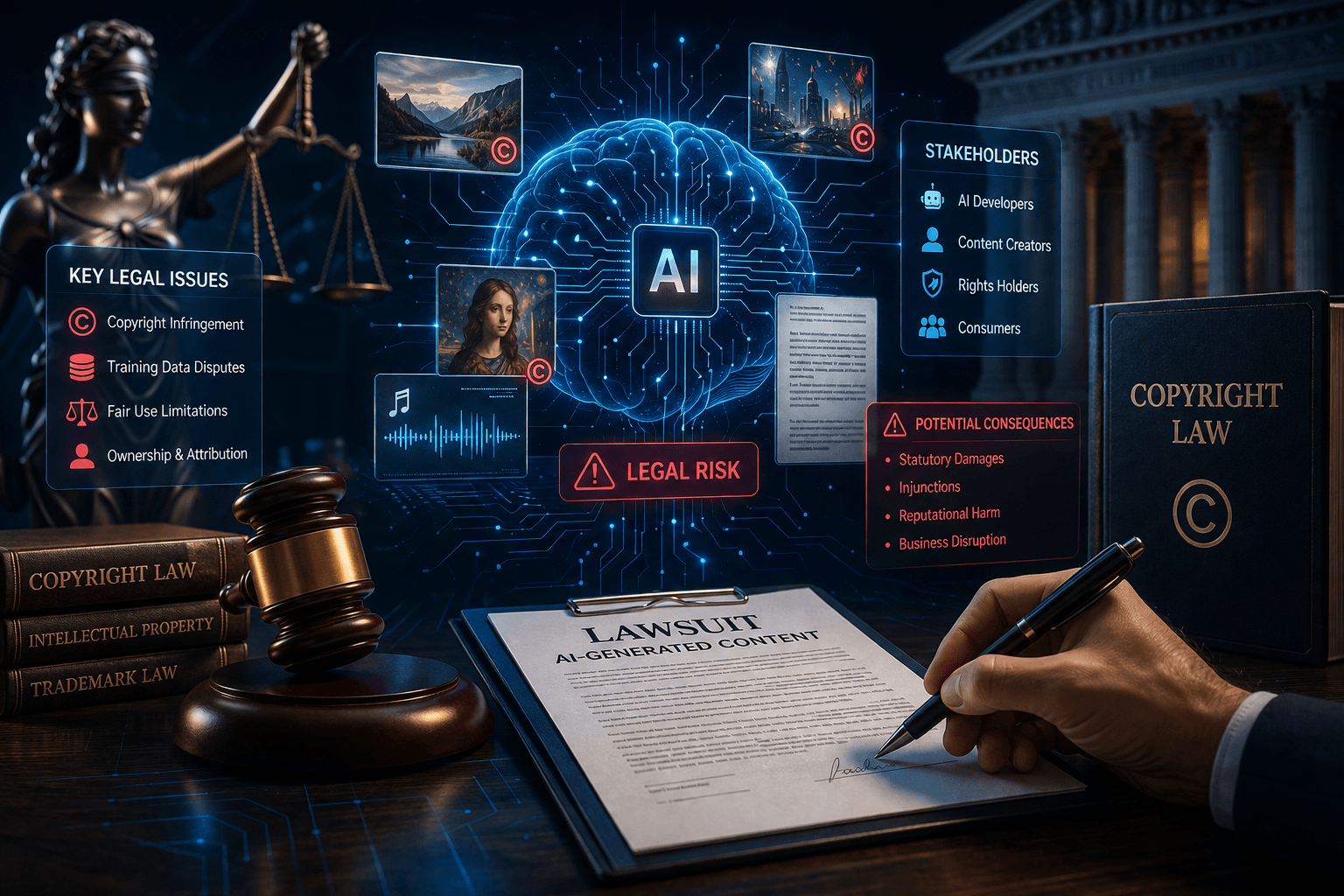
Artificial intelligence is rapidly transforming how we create and consume content. From stunning visual art to insightful written articles and complex code, AI tools are democratizing creation and pushing the boundaries of innovation. However, this surge in AI-generated content has also ignited a complex legal debate, particularly around copyright law. As AI systems learn from vast datasets of existing works, questions arise about originality, authorship, and infringement. The legal landscape is struggling to keep pace, leading to high-profile AI copyright lawsuits that could set crucial precedents. This blog post aims to dissect these emerging legal challenges, providing clarity on the current state of AI and copyright law.
Quick Answer: AI copyright lawsuits arise because current copyright laws were designed for human creators, making it difficult to apply them to works generated by machines. Key issues include determining authorship, ownership, and whether AI training data or output infringes on existing copyrights. The outcome of these cases will significantly shape how AI-generated content is treated legally.
Understanding Copyright Law Basics in the Digital Age
- Explain fundamental copyright principles (originality, authorship, etc.).
- Discuss how copyright law traditionally applies to human-created works.
- Address the challenges of applying these principles to AI-generated content.
- Mention the concept of 'fair use' and its relevance.
Copyright law, at its core, protects original works of authorship fixed in a tangible medium of expression. This typically requires human creativity and intellectual labor. For centuries, this framework has successfully governed the rights of authors, artists, musicians, and programmers. However, the advent of sophisticated AI challenges these foundational principles. Can a machine be an 'author'? Is content generated by an algorithm truly 'original' in the legal sense? Applying traditional copyright doctrines to AI-generated works is proving to be a significant hurdle. Concepts like 'fair use,' which allows limited use of copyrighted material without permission for purposes such as criticism or education, also face new interpretations in the context of AI training and output.
The CNN vs. Perplexity Lawsuit: A Case Study
- Detail the specifics of the CNN vs. Perplexity lawsuit (allegations, key arguments).
- Analyze the legal implications of Perplexity's AI-powered search and summarization.
- Discuss the potential impact of the lawsuit's outcome on the AI industry.
- Explore the arguments around whether AI-generated summaries infringe on copyright.
The lawsuit filed by CNN against Perplexity AI serves as a critical example of the legal battles unfolding in the AI space. CNN alleges that Perplexity, an AI-powered search engine, unlawfully used its copyrighted articles to train its AI models and generate summaries without proper attribution or permission. Perplexity's core functionality involves synthesizing information from various sources, including news articles, to provide direct answers and summaries to users. CNN argues that this process constitutes copyright infringement, as their original journalistic work is being repurposed and potentially undermining their own content's value. The legal arguments will likely revolve around whether Perplexity's actions fall under fair use, the definition of derivative works, and the extent to which AI summarization constitutes unauthorized reproduction and distribution. The outcome of this case could significantly influence how AI companies utilize publicly available online content for training and how news organizations protect their intellectual property in the age of AI.
Authorship and Ownership: Who Owns AI-Generated Content?
- Examine the debate surrounding authorship of AI-generated works.
- Discuss the role of the AI developer, the user, and the AI itself.
- Analyze existing legal precedents and their applicability.
- Explore the concept of 'joint authorship' in the context of AI.
One of the most fundamental questions in AI copyright law is: who is the author? Traditional copyright law vests authorship in human creators. However, with AI, the lines blur. Is the author the programmer who developed the AI algorithm? Is it the user who provided the prompt or parameters that guided the AI's creation? Or could the AI itself, in some future legal framework, be considered an author? Current legal systems generally require human authorship for copyright protection. For instance, the US Copyright Office has stated that works generated solely by AI without sufficient human creative input are not eligible for copyright. This leaves a significant gap for AI-assisted or AI-generated content. Concepts like 'joint authorship,' where multiple individuals contribute to a single work, might offer a partial solution, but defining the respective contributions of humans and AI remains a complex challenge. The lack of clear ownership can hinder commercialization and create uncertainty for both creators and businesses utilizing AI.
Fair Use and AI: A Balancing Act
- Explain the 'fair use' doctrine and its four factors.
- Analyze how these factors apply to AI-generated content (purpose, nature, amount, market effect).
- Discuss the potential for AI to be used for transformative purposes.
- Provide examples of AI uses that may or may not qualify as fair use.
The doctrine of 'fair use' is a crucial defense against copyright infringement claims, allowing for the limited use of copyrighted material without permission under certain circumstances. The four factors considered are: the purpose and character of the use (e.g., commercial vs. non-profit, transformative), the nature of the copyrighted work, the amount and substantiality of the portion used, and the effect of the use upon the potential market for or value of the copyrighted work. Applying these factors to AI is challenging. For example, using copyrighted text to train an AI model might be argued as transformative, especially if the AI generates entirely new content. However, if the AI output closely mimics or competes with the original work, the 'market effect' factor weighs against fair use. Similarly, using AI to generate summaries of news articles could be seen as transformative, but if it reduces the need for users to visit the original source, it impacts the market. Determining fair use in AI contexts requires a careful, case-by-case analysis, balancing the interests of copyright holders with the potential for AI to foster creativity and innovation.
Legal Strategies for Content Creators and AI Developers
- Offer advice to content creators on protecting their work from AI infringement.
- Suggest strategies for AI developers to mitigate copyright risks.
- Discuss the importance of clear terms of service and licensing agreements.
- Highlight the role of AI detection tools in identifying potential infringement.
Navigating the complex terrain of AI and copyright requires proactive strategies for both content creators and AI developers. Creators should focus on clearly marking their work, understanding the terms of service for AI tools they use, and potentially employing digital watermarking or other methods to track usage. Registering copyrights for original works remains a fundamental step. For AI developers, the focus should be on ethical data sourcing, ensuring training datasets are properly licensed or fall under fair use exceptions, and building transparency into their AI models. Implementing robust terms of service that clearly define usage rights and limitations is essential. Furthermore, developing and utilizing AI detection tools can help identify instances where AI-generated content might be infringing on existing copyrights, providing valuable evidence for legal recourse. Clear licensing agreements for both input data and output content are paramount to avoiding disputes.
The Future of AI and Copyright Law: Predictions and Trends
- Discuss potential legislative changes and legal developments.
- Explore the role of international copyright treaties.
- Predict the future of AI copyright lawsuits and their impact on innovation.
- Address the ethical considerations surrounding AI and copyright.
The legal landscape surrounding AI and copyright is in constant flux. We can anticipate more legislative bodies and courts grappling with these issues, potentially leading to new laws or interpretations specifically addressing AI-generated works. International copyright treaties may need updating to harmonize global approaches. The frequency of AI copyright lawsuits is likely to increase as the technology becomes more integrated into creative industries. These legal battles will inevitably shape the trajectory of AI innovation, potentially encouraging more cautious development or spurring new legal frameworks. Ethical considerations are also paramount; ensuring fair compensation for human creators whose work contributes to AI training data, and maintaining transparency about AI's role in content creation, will be critical for public trust and responsible technological advancement. The ongoing dialogue between technologists, legal experts, policymakers, and creators is essential for forging a path forward that fosters innovation while respecting intellectual property rights.
Conclusion: Navigating the Complex Landscape
- Summarize the key legal challenges surrounding AI and copyright.
- Reiterate the importance of understanding these issues for legal professionals and content creators.
- Emphasize the need for ongoing dialogue and legal clarity.
- CTA: Learn how BigOsoft can help you navigate the complexities of AI and copyright law. Contact us today for a consultation.
The intersection of artificial intelligence and copyright law presents a significant legal minefield, marked by complex questions of authorship, ownership, and infringement. As AI-generated content proliferates, understanding these evolving legal challenges is crucial for content creators, AI developers, and legal professionals alike. The outcomes of landmark cases like CNN vs. Perplexity will undoubtedly shape future practices and regulations. While the path forward requires ongoing dialogue, adaptation, and legal clarity, navigating these complexities is essential for fostering responsible innovation. At BigOsoft, we understand the intricate challenges posed by AI in the digital landscape. Let us help you navigate the complexities of AI and copyright law. Contact us today for a consultation.