
Introduction: The Rise of AI Agents in SaaS
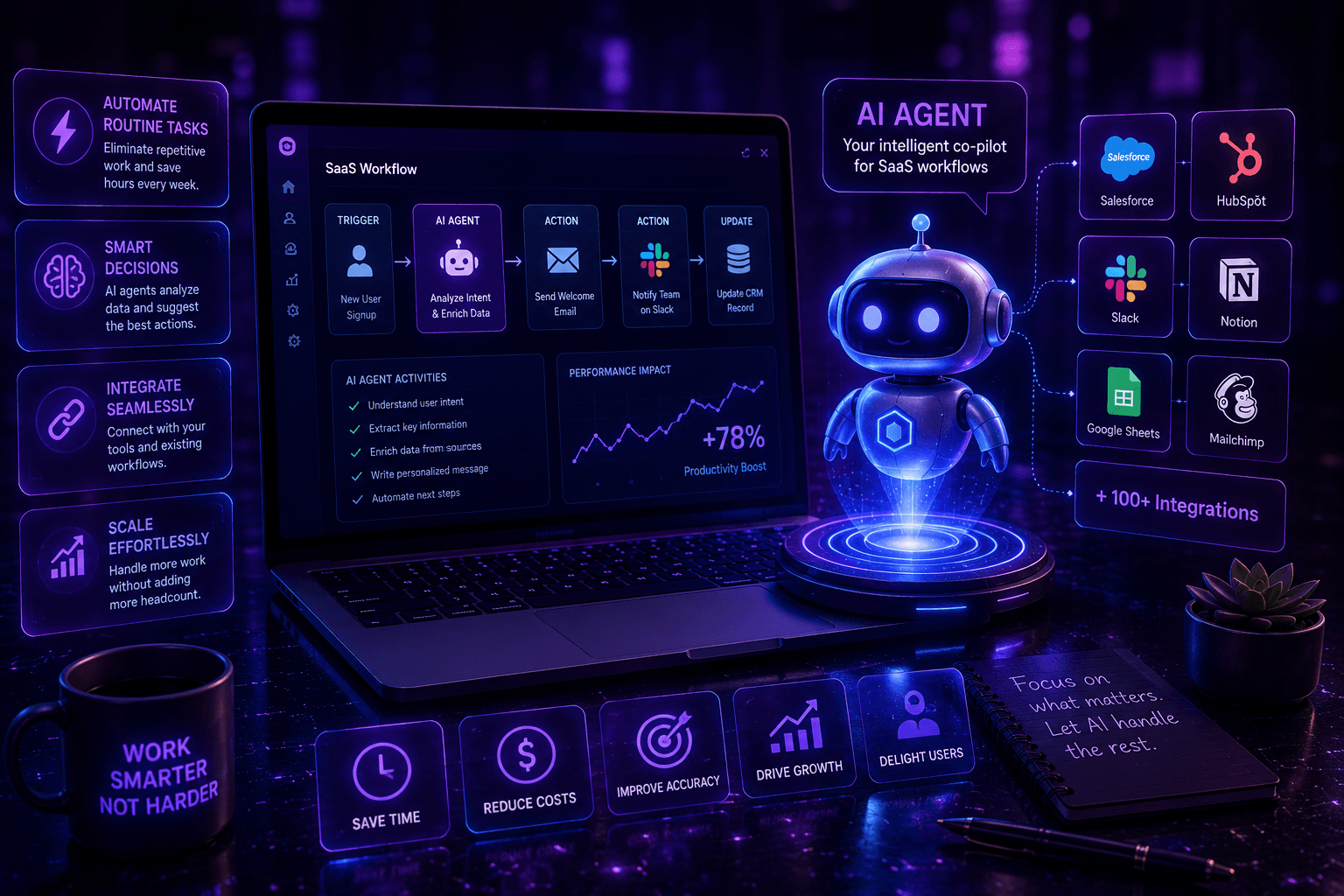
In today's rapidly evolving digital landscape, businesses are constantly seeking innovative ways to streamline operations and enhance efficiency. Artificial Intelligence (AI) agents are emerging as a transformative force, particularly within the Software as a Service (SaaS) sector. These intelligent autonomous programs are designed to perform specific tasks, learn from their environment, and make decisions with minimal human intervention. Their capabilities range from simple data processing to complex problem-solving, making them ideal candidates for automating a myriad of functions within SaaS platforms. The increasing adoption of AI agents in SaaS environments is not just a trend; it's a fundamental shift towards more intelligent, automated, and productive workflows. At BigOsoft, we understand the profound potential of AI agents and possess the expertise to implement these solutions, empowering your SaaS business to achieve unprecedented levels of efficiency and productivity.
Quick Answer: AI Agents for SaaS Productivity
AI agents are revolutionizing SaaS workflows by automating repetitive tasks, enhancing data analysis, and personalizing customer interactions. This intelligent automation frees up human resources for strategic initiatives, reduces operational costs, and minimizes errors, ultimately leading to significant productivity gains and improved business outcomes.
Understanding the Core Benefits of AI Agents for SaaS
- Improved Efficiency: AI agents excel at automating repetitive, time-consuming tasks and entire processes, allowing for faster execution and higher throughput.
- Enhanced Productivity: By taking over routine duties, these agents free up human employees to focus on more complex, creative, and strategic work that requires human ingenuity and critical thinking.
- Reduced Errors: AI agents perform tasks with a high degree of accuracy, minimizing the potential for human error in data entry, processing, and analysis, leading to more reliable outcomes.
- Cost Savings: Automation through AI agents can significantly lower operational costs by reducing the need for manual labor, minimizing errors that lead to rework, and optimizing resource allocation.
Key Use Cases: How AI Agents are Transforming SaaS Workflows
The versatility of AI agents allows them to be applied across various functions within a SaaS platform, driving tangible improvements. Here are some key use cases:
- Customer Support: AI-powered chatbots and virtual assistants provide instant, 24/7 customer service, answering queries, resolving issues, and escalating complex problems to human agents when necessary.
- Data Analysis: Intelligent agents can automate data mining, identify patterns, generate insights, and create reports, enabling faster and more informed decision-making.
- Sales Automation: AI agents can assist with lead qualification, personalized outreach, scheduling meetings, and even managing parts of the sales pipeline, improving sales team efficiency.
- Marketing Automation: These agents can optimize marketing campaigns, personalize content creation, analyze campaign performance, and manage social media interactions.
- Security Monitoring: AI agents can continuously monitor systems for threats, detect anomalies, and automate incident response, enhancing the overall security posture of the SaaS platform.
Implementing AI Agents: A Step-by-Step Guide for SaaS Platforms
- Identifying suitable tasks for AI agent automation: Start by analyzing your current workflows to pinpoint repetitive, data-intensive, or rule-based tasks that are prime candidates for automation.
- Selecting the right AI agent platform and tools: Evaluate different AI platforms and tools based on your specific needs, technical capabilities, scalability, and budget.
- Integrating AI agents with existing SaaS infrastructure: Plan a seamless integration process to ensure AI agents can communicate effectively with your current systems, databases, and APIs.
- Training and fine-tuning AI agents for optimal performance: Dedicate resources to train your AI agents with relevant data and continuously fine-tune their algorithms to improve accuracy and efficiency.
- Monitoring and evaluating AI agent effectiveness: Establish key performance indicators (KPIs) to track the performance of your AI agents and make necessary adjustments to ensure they meet business objectives.
Overcoming Challenges in AI Agent Implementation
While the benefits are substantial, implementing AI agents can present challenges. Addressing these proactively is key to successful deployment:
- Data quality and availability: AI agents rely on high-quality, accessible data. Ensuring data integrity and availability is crucial for effective training and operation.
- Integration complexities with legacy systems: Integrating new AI technologies with older, established systems can be technically challenging and require careful planning.
- Ensuring data privacy and security: Robust measures must be in place to protect sensitive data processed by AI agents, complying with regulations like GDPR and CCPA.
- Addressing ethical considerations and bias: It's vital to identify and mitigate potential biases in AI algorithms to ensure fair and equitable outcomes.
- Managing user adoption and change management: Effectively communicating the benefits of AI agents and providing adequate training can help overcome resistance and ensure smooth adoption by employees.
Measuring the ROI of AI Agent Investments
To justify the investment in AI agents, it's essential to measure their return on investment (ROI). This involves tracking several key metrics:
- Key performance indicators (KPIs) for AI agent success: Define specific KPIs such as task completion time, accuracy rates, error reduction percentages, and customer satisfaction scores.
- Tracking productivity gains and cost savings: Quantify the time saved by automating tasks and calculate the reduction in operational costs compared to manual processes.
- Monitoring customer satisfaction and engagement: Measure improvements in customer response times, resolution rates, and overall customer happiness.
- Analyzing the impact on revenue and profitability: Ultimately, assess how increased efficiency, improved customer satisfaction, and optimized operations contribute to revenue growth and profitability.
The Future of AI Agents in SaaS: Trends and Predictions
The evolution of AI agents is rapid, and their role in SaaS will only expand. Several key trends are shaping the future:
- Increasing sophistication of AI agent capabilities: Agents will become more adept at handling complex reasoning, natural language understanding, and proactive problem-solving.
- Integration with other emerging technologies: Expect deeper integration with IoT devices, blockchain, and other advanced technologies to create more comprehensive automated solutions.
- The rise of personalized and adaptive AI agents: AI agents will become more tailored to individual user needs and adapt dynamically to changing environments and user behaviors.
- Growing importance of AI agent governance and ethics: As AI agents become more autonomous, establishing clear governance frameworks and ethical guidelines will be paramount.
Conclusion: Unlock the Power of AI Agents with BigOsoft
AI agents offer a powerful pathway for SaaS platforms to achieve significant workflow transformation and productivity gains. By automating tasks, enhancing decision-making, and improving customer experiences, these intelligent systems are becoming indispensable tools for growth and efficiency. At BigOsoft, we are at the forefront of AI agent implementation, offering tailored solutions to help your business harness this transformative technology. Our expertise ensures a smooth integration and optimal performance, allowing you to unlock the full potential of AI for your SaaS operations. Let us help you navigate the complexities and realize the immense benefits.
In the context of SaaS, an AI agent is a software program that uses artificial intelligence to perform tasks autonomously, learn from data, and make decisions to achieve specific business objectives, such as automating customer support or analyzing data. AI agents can improve your company's bottom line by increasing operational efficiency, reducing errors, lowering labor costs through automation, and enhancing customer satisfaction, all of which contribute to increased profitability. Integrating AI agents can range in difficulty depending on the complexity of your existing infrastructure and the specific AI solution chosen; however, with proper planning and expert guidance, seamless integration is achievable. The biggest risks often involve data privacy and security concerns, potential algorithmic bias, and the challenges of user adoption and change management, all of which can be mitigated with careful planning and ethical considerations.
CTA: Transform Your SaaS Platform with BigOsoft
Ready to elevate your SaaS platform with the power of AI agents? BigOsoft offers expert services to help you identify opportunities, implement cutting-edge AI solutions, and measure their impact. Contact us today to learn more about our AI solutions, request a demo of our AI agent implementation services, or schedule a consultation to discuss your specific business needs and discover how BigOsoft can help you achieve your goals.