
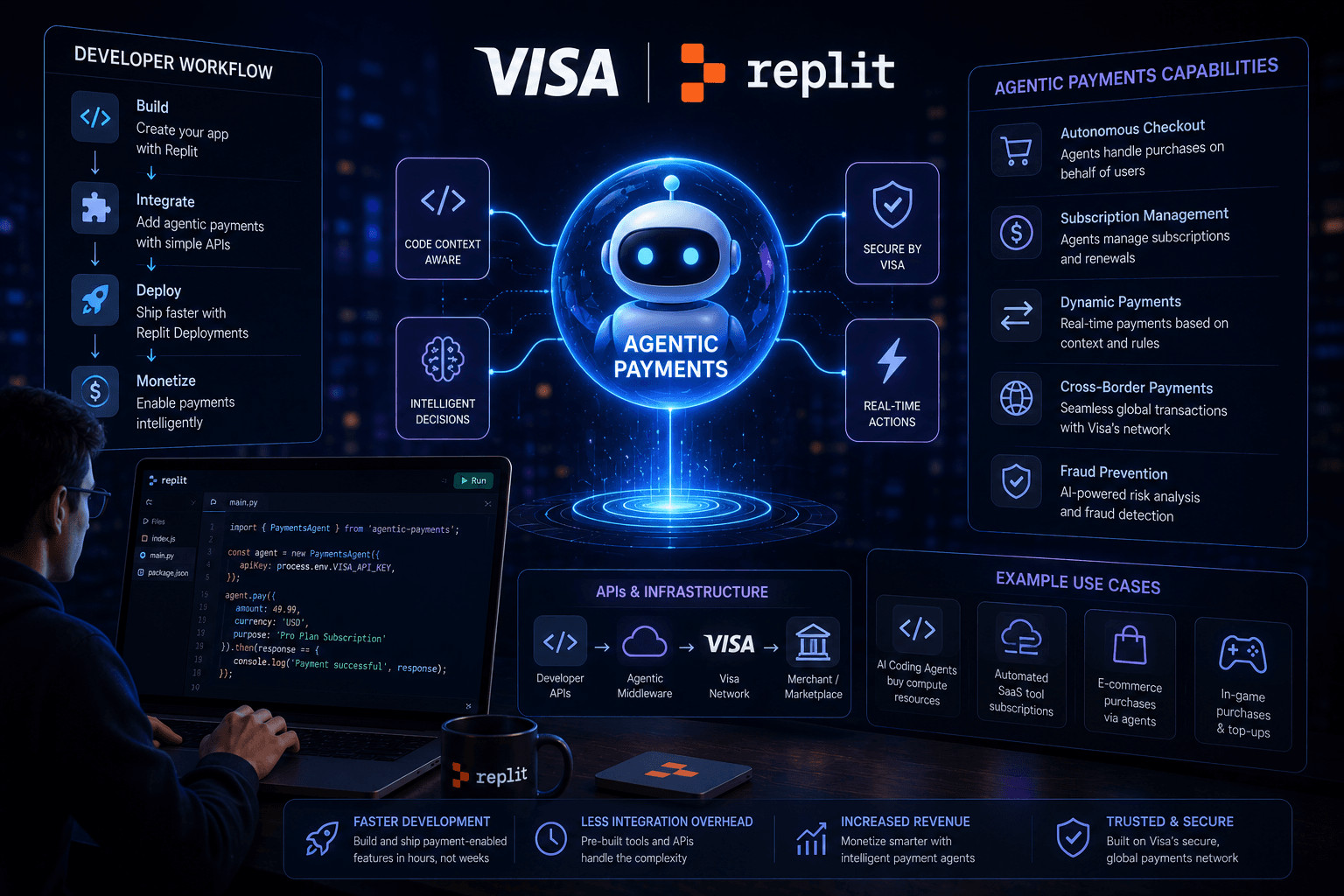

The world of software development is constantly evolving, driven by innovation and the relentless pursuit of efficiency. At the forefront of this evolution is the concept of agentic payments, a paradigm shift that promises to automate financial transactions within development workflows. Visa's recent strategic investment in Replit, a collaborative coding platform, signals a significant move towards realizing this future. This investment could very well be the catalyst that revolutionizes how developers interact with financial systems, making payments seamless, intelligent, and autonomous. Understanding agentic payments is no longer just a niche interest; it's becoming crucial for developers looking to stay ahead.
What are Agentic Payments and Why Should Developers Care?
Agentic payments refer to financial transactions that are initiated, managed, and executed autonomously by software agents or artificial intelligence. Instead of manual intervention or complex, custom API integrations, these agents can intelligently handle payments based on predefined rules, real-time data, or smart contract conditions. For developers, the current payment landscape often involves a tedious mix of manual processes, setting up and maintaining intricate API connections, and dealing with the inherent limitations of these systems, such as potential errors and delays. Agentic payments offer a compelling alternative, promising enhanced automation, greater efficiency, a significant reduction in errors, and the potential for entirely new revenue streams through innovative business models. As software development becomes more interconnected and reliant on external services, the need for seamless, intelligent payment solutions is growing exponentially.
Visa's Investment in Replit: A Strategic Move Towards Agentic Payments?
Visa's substantial investment in Replit is a clear indicator of its interest in the future of developer tooling and embedded finance. Replit, with its robust collaborative coding environment, provides an ideal testing ground and integration point for advanced payment solutions. By investing in Replit, Visa is not just backing a popular platform; it's strategically positioning itself to influence and benefit from the integration of financial services directly into the developer workflow. Visa's extensive global payment infrastructure, security expertise, and deep understanding of financial ecosystems can significantly enhance Replit's capabilities, paving the way for sophisticated embedded finance solutions. We can anticipate a future where payments are not an afterthought but an integral, automated part of the coding experience on platforms like Replit.
How Agentic Payments Can Transform Developer Workflows
- Automated billing and subscription management for SaaS applications, freeing developers from manual invoicing and payment tracking.
- Dynamic pricing and payment adjustments based on real-time usage metrics or service performance, ensuring fair and efficient cost allocation.
- Enabling microtransactions and pay-as-you-go models for APIs and services, making specialized tools more accessible and cost-effective.
- Streamlined royalty payments for open-source contributors, fostering a more sustainable ecosystem for collaborative development.
- Automated payouts to freelancers and contractors within development teams, simplifying payroll and ensuring timely compensation.
Use Cases: Real-World Applications of Agentic Payments for Developers
- Automated payment processing for cloud computing resources: Agents can monitor resource consumption and automatically pay cloud providers, optimizing costs and preventing service interruptions.
- Smart contracts for secure and transparent code licensing: Payments can be automatically triggered upon code usage or distribution, enforced by smart contracts for trustless transactions.
- AI-powered fraud detection and prevention in payment systems: Intelligent agents can analyze transaction patterns in real-time to identify and block fraudulent activities, enhancing security.
- Automated affiliate payouts based on performance metrics: Marketing or referral programs can automatically disburse payments to affiliates once predefined performance targets are met.
Challenges and Considerations for Implementing Agentic Payments
- Security risks and vulnerabilities associated with autonomous payment systems require robust safeguards against unauthorized access and manipulation.
- Regulatory compliance and legal frameworks for agentic payments are still evolving, necessitating careful navigation of financial regulations.
- Data privacy and protection concerns are paramount, as these systems handle sensitive financial information.
- Ensuring transparency and auditability of payment transactions is crucial for trust and accountability.
- Scalability and reliability of agentic payment infrastructure must be addressed to handle high volumes and ensure consistent operation.
The Future of Agentic Payments in the Developer Ecosystem
The adoption of agentic payments is poised for significant growth. As AI and machine learning technologies mature, they will play an increasingly vital role in optimizing payment processes, predicting potential issues, and enhancing security. Emerging trends like the integration of decentralized finance (DeFi) could further revolutionize agentic payments, offering new models for ownership, governance, and transaction settlement. Ultimately, the widespread implementation of agentic payments promises to dramatically boost developer productivity, reduce administrative overhead, and unlock new avenues for innovation, allowing developers to focus more on creating groundbreaking software and less on managing financial logistics. This shift is fundamental to the evolution of how software is built and monetized.
Getting Started with Agentic Payments: Tools and Resources for Developers
Embarking on the journey of agentic payments involves leveraging available APIs, SDKs, and specialized platforms designed for building autonomous financial solutions. Prioritizing security best practices and understanding relevant compliance guidelines are non-negotiable steps. Developers should explore documentation, tutorials, and community forums for insights and support. Choosing the right payment infrastructure depends heavily on specific project needs, transaction volumes, and desired levels of automation. Resources from major financial institutions and fintech providers are becoming increasingly accessible, lowering the barrier to entry.
Frequently Asked Questions
- What is the main benefit of agentic payments for developers? Agentic payments automate financial transactions, leading to increased efficiency, reduced errors, and the potential for new revenue models.
- How does Visa's investment in Replit relate to agentic payments? Visa's investment suggests a strategic interest in integrating advanced financial capabilities, like agentic payments, directly into developer platforms.
- Are agentic payment systems secure? Security is a major consideration. Robust security measures, encryption, and AI-driven fraud detection are essential for protecting autonomous payment systems.
- What are some potential challenges? Key challenges include ensuring security, navigating evolving regulations, protecting data privacy, and maintaining system transparency and reliability.
Ready to Implement Agentic Payments?
BigOsoft offers comprehensive solutions for integrating agentic payments into your development workflows. Contact us today to learn more about our services and how we can help you leverage the power of automated payments. Explore our website for case studies, white papers, and other valuable resources. Let BigOsoft be your partner in building the future of finance.