
Introduction: The Future of Gaming is AR
Augmented reality (AR) gaming has moved beyond novelty into a rapidly evolving landscape. While mobile AR games have offered glimpses of interactive digital overlays on the real world, the true potential for deeply immersive and seamlessly integrated gaming experiences lies with dedicated AR gaming glasses. These devices promise to blend the physical and digital realms like never before, ushering in a new era of play. This article delves into the crucial features and underlying technologies that developers must understand to build the next generation of AR gaming glasses, paving the way for truly revolutionary interactive entertainment.
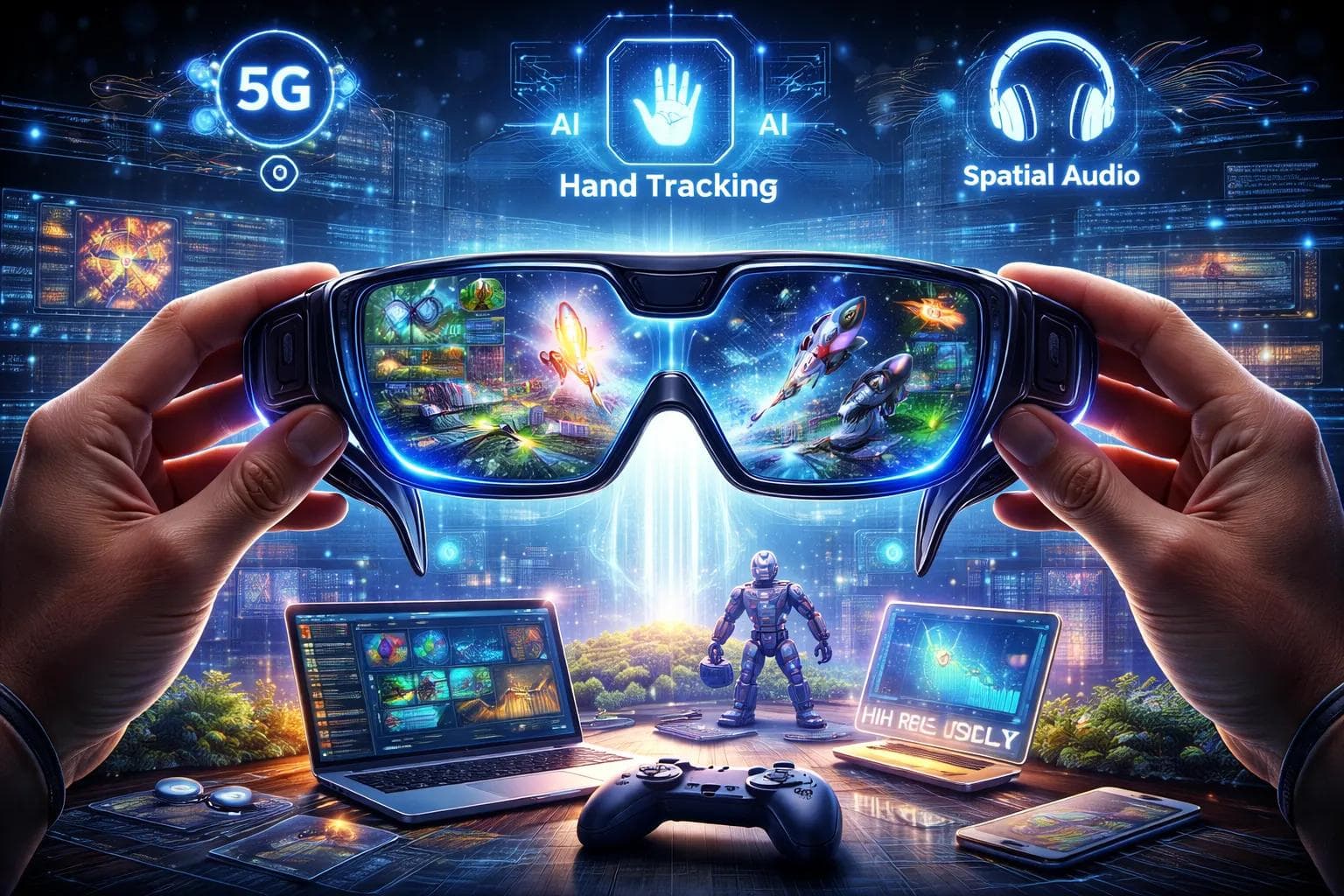
Quick Answer: Next-gen AR gaming glasses require high-resolution displays and advanced optics for visual fidelity, powerful processing for complex rendering, sophisticated sensors for environmental understanding, seamless connectivity for multiplayer and cloud gaming, and intuitive input methods for natural interaction. Robust developer tools are also essential for creating compelling experiences.
High-Resolution Displays and Optics: Visual Fidelity is Key
The foundation of any compelling AR gaming experience is visual fidelity. For AR gaming glasses, this translates to incredibly sharp and vibrant displays capable of rendering digital elements that appear as real as their physical surroundings. Technologies like micro-OLED and micro-LED are paramount here, offering superior brightness, contrast ratios, and pixel density compared to traditional displays. These advancements are crucial for displaying intricate details, realistic textures, and clear text within the virtual overlays. Equally important are the optics. Waveguide technology, for instance, plays a critical role in directing light from the displays to the user's eyes efficiently, enabling a wide field of view (FOV) without bulky lenses. Achieving a broad FOV is essential for immersion, preventing the feeling of looking through a small window. Furthermore, minimizing latency between the device's processing and what the user sees, coupled with high refresh rates, is vital to combat motion sickness and ensure that virtual objects respond instantly to user movements, enhancing the sense of presence and realism.
Powerful Processing and Graphics: Unleashing AR Potential
Rendering complex, dynamic AR environments in real-time, while simultaneously processing user input and tracking environmental data, demands significant computational power. Next-gen AR gaming glasses need processors capable of handling these intensive tasks without compromising performance. This often involves dedicated GPUs or specialized AR processors, such as Qualcomm's Snapdragon XR series (e.g., XR2), which are optimized for mixed reality applications. These chips are designed to efficiently manage graphics rendering, AI processing for object recognition, and sensor fusion. However, raw power isn't enough; efficient power management is a critical challenge. AR glasses are typically battery-powered and worn for extended periods, making battery life a key consideration. Developers and hardware manufacturers must work together to optimize software and hardware for maximum performance with minimal energy consumption, ensuring gamers can enjoy long, uninterrupted sessions.
Advanced Sensors and Tracking: Precise Environmental Understanding
For AR to feel truly integrated, the glasses must accurately understand the user's environment and their position within it. This requires a sophisticated suite of sensors. High-quality cameras are essential for capturing visual data of the surroundings, enabling the system to recognize surfaces, objects, and even people. Inertial Measurement Units (IMUs), comprising accelerometers and gyroscopes, track the precise orientation and movement of the user's head. Depth sensors, such as LiDAR or structured light, provide crucial information about the distance to objects, allowing for realistic occlusion (where virtual objects appear behind real ones) and accurate placement of digital content. The integration of these sensors is powered by advanced algorithms, most notably SLAM (Simultaneous Localization and Mapping). SLAM enables the device to build a map of its environment while simultaneously tracking its own location within that map, providing robust and low-latency tracking essential for a believable AR experience.
Seamless Connectivity: Enabling Multiplayer and Cloud Gaming
The future of AR gaming is inherently social and often cloud-dependent. Fast, reliable wireless connectivity is therefore non-negotiable. Technologies like Wi-Fi 6E and 5G are crucial for enabling seamless multiplayer experiences, allowing multiple users to interact within the same shared AR space with minimal lag. Low-latency communication is paramount; even milliseconds of delay can break immersion and frustrate players in fast-paced games. Beyond multiplayer, cloud gaming and edge computing offer exciting possibilities. By offloading computationally intensive tasks to powerful servers in the cloud or at the network edge, AR glasses can become lighter, more power-efficient, and capable of rendering incredibly complex graphics and simulations. This allows for richer, more detailed AR worlds without taxing the device's onboard resources, further enhancing the gaming experience.
Intuitive Input and Interaction: Natural User Interfaces
Traditional gaming controllers, while effective for many genres, can feel cumbersome and out of place in an AR environment. The goal of AR is to blend the digital with the physical seamlessly, and input methods should reflect this. Next-gen AR gaming glasses need to support more natural and intuitive forms of interaction. Hand tracking, allowing users to manipulate virtual objects with their bare hands, is a prime example. Voice control for commands and interactions, and gesture recognition for specific actions, further enhance the feeling of direct manipulation. Developing user interfaces that are both powerful and easy to learn is a key challenge for developers. The aim is to create interactions that feel as natural as interacting with the real world, minimizing the learning curve and maximizing immersion.
Developer Tools and SDKs: Empowering AR Game Creation
The most advanced hardware is only as good as the software it runs. For developers to truly harness the potential of next-gen AR gaming glasses, robust and accessible development tools are essential. This includes comprehensive Software Development Kits (SDKs) that provide the necessary APIs and libraries for accessing device features like sensors, displays, and tracking systems. Major game development platforms like Unity and Unreal Engine are already investing heavily in AR capabilities, offering powerful engines and visual scripting tools that simplify the creation of complex AR experiences. Beyond the core tools, readily available documentation, extensive tutorials, example projects, and strong community support are vital. These resources empower developers, from indie studios to large enterprises, to overcome technical hurdles and focus on creating innovative, engaging, and polished AR gaming content.
Conclusion: The Dawn of a New Gaming Era
The convergence of high-resolution displays, powerful processing, advanced sensors, seamless connectivity, and intuitive interaction methods is setting the stage for a revolution in gaming. Next-generation AR gaming glasses are poised to deliver experiences that were once confined to science fiction, offering unparalleled immersion and interactivity. For developers, understanding these key technologies and leveraging the right tools is crucial to building the groundbreaking games that will define this new era. The potential for AR gaming is immense, promising to transform how we play, interact, and engage with digital content. Embracing AR development now means being at the forefront of this exciting evolution.
FAQ
- What is the main advantage of AR gaming glasses over traditional consoles?
- How do AR glasses ensure a comfortable viewing experience?
- What kind of games are best suited for AR?
- Will AR gaming glasses require a powerful PC?
- How can developers get started with AR game development?
CTA: Ready to Build the Future of AR Gaming?
The landscape of AR gaming is expanding rapidly, and BigOsoft is at the forefront, ready to help you create the next generation of immersive experiences. Our expert team specializes in cutting-edge AR development, leveraging the latest technologies to bring your vision to life. Explore our comprehensive AR development services and discover how we can partner with you to build groundbreaking games and applications. Contact us today for a consultation and let's shape the future of interactive entertainment together.